
Costa Rica electricity is cheap by North American standards. In Playas del Coco, homes pay about 14 to 19 US cents per kWh in 2026. Almost all of it is renewable. In 2025, 97.3% of the country’s power came from water, wind, geothermal heat and the sun. Most of it is hydro. That is why a dry year matters. When the rivers and reservoirs drop, the grid burns more fuel and the risk of power cuts goes up.
The 2026–27 dry season is shaping up as one of those years. A strong El Niño is in place and Guanacaste has had far less rain than normal. The state utility, ICE, is adding 373 megawatts (MW) of backup for the season. That includes five new solar plants in Guanacaste. One of them, Los Mangos, is in Carrillo, the canton that includes Playas del Coco.
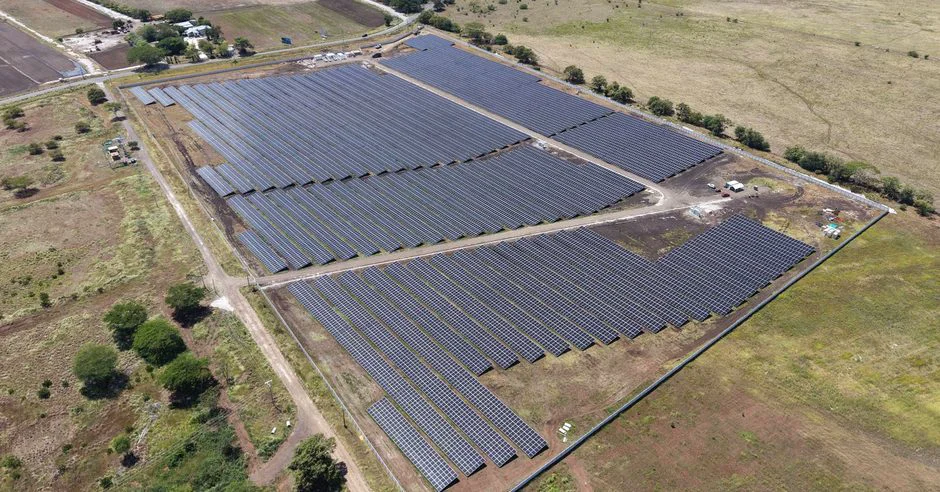
One of five new private solar plants in Guanacaste, November 2026. Photo: Grupo ICE.
Table Of Contents
What Electricity Costs in Playas del Coco
ICE runs the grid, but local distribution is split between ICE, cooperatives and municipal companies. In Playas del Coco and the rest of Carrillo, the distributor is Coopeguanacaste. It also serves Santa Cruz, Nicoya and other cantons to the south. Rates are set each year by the regulator, ARESEP.
Coopeguanacaste’s 2026 residential rate (ARESEP RE-0072-IE-2025):
| Monthly use | Price | About in USD |
|---|---|---|
| First 30 kWh | ₡1,831.50 flat | $4.12 |
| 31 to 200 kWh | ₡61.05 per kWh | $0.14 per kWh |
| Over 200 kWh | ₡86.07 per kWh | $0.19 per kWh |
USD figures use ₡445 to the dollar, the exchange rate in mid-November 2026. Once a home uses more than 280 kWh in a month, 13% sales tax (IVA) applies to the whole bill. Energy plus sales tax works out to:
- 200 kWh (small home, no air conditioning): about ₡12,200, or $27.
- 300 kWh: about ₡23,500 with tax, or $53.
- 600 kWh (air conditioning in the bedrooms, pool pump): about ₡52,700 with tax, or $118.
Air conditioning and a clothes dryer can push a bill far past these examples, especially in the dry season. Two habits save money. Hang laundry to dry instead of using the dryer. Leave the windows open at night instead of running the air conditioning.
The residential rate is for homes people live in. The tariff rules exclude vacation houses (“casas de recreo”) and properties used for business. A home run as a short-term rental may be billed at the commercial rate, which is ₡90.07 per kWh for energy-only service at Coopeguanacaste. Ask the distributor which rate applies before you count on the lower one.
Rates for 2027 are not set yet. ARESEP warned in July 2026 that the extra fuel burned for thermal power could push 2027 rates up. A separate mid-year increase of about 8% was dropped in August 2026 after ICE said it could absorb the cost.
Power Cuts and Backup in Coco
Rationing is rare. Local outages are not. In Playas del Coco, a storm or a tree falling on a line can cut power, and on occasion a cut lasts up to eight hours. Power has become more reliable as the area has built up, but it is not perfect.
A home on a well depends on its pump, so a power cut also cuts the water. A small generator or battery that runs the pump and the fridge is the usual answer for a full-time resident.
Rentals are different. Some owners have a diesel generator wired into the home’s electrical system. It is a costly upgrade, but for a short-term rental it is usually worth it. A guest does not care that a tree came down on a line. They care that the wifi stopped working.
Where Costa Rica’s Electricity Comes From
ICE runs the national grid and publishes the generation mix every year. Hydro carries the system. Wind and geothermal plants in Guanacaste and the north supply most of the rest. Thermal plants that burn diesel and bunker fuel fill the gap in dry years.
| Year | Renewable share of demand | Thermal share of demand | What happened |
|---|---|---|---|
| 2023 | 91.3% | 5.0% | El Niño year, low reservoirs |
| 2024 | 86.8% | 10.4% | Reservoirs still low, cuts announced in May |
| 2025 | 97.3% | 1.4% | Normal rains, hydro recovered |
Imports from neighbouring countries make up the small remainder.
In 2025, hydro supplied 73.6% of demand and solar only 0.28%. The national system had just 15.5 MW of solar capacity, out of 3,658.6 MW in total.
Thermal power costs more to produce. In a dry year that cost feeds into the next rate review. It does not change a home’s bill the same month.
El Niño and the 2026–27 Dry Season
Guanacaste’s dry season runs from about December to April. El Niño usually makes it drier and hotter. The 2026–27 event is a strong one.
- NOAA, 12 November 2026: a strong to very strong El Niño is likely to last through January to March 2027.
- Costa Rica’s weather service (IMN), October 2026: El Niño is expected to last until at least July 2027.
- Guanacaste rain: much of the province had almost no rain in May 2026, when about 200 mm is typical. IMN projected September rain in the North Pacific at up to 80% below normal.
ICE expects river flows to fall 15% to 25%, mostly on the Pacific side. It has said it does not plan scheduled power cuts. In August 2026, ICE’s head of hydroclimatology said there would be no cuts this El Niño season. In May 2026, an internal ICE document called 2027 tight. ICE said there was no immediate risk.
The 373 MW plan is ICE’s answer. About 100 MW is solar: the five Guanacaste plants below plus an ICE plant in La Uruca, San José. The other 273 MW is temporary thermal generation available from 1 January 2027 and kept on the grid until 2029. ICE says the extra capacity equals about 11% of what the national system has now.
What Happened in 2024
On 8 May 2024, ICE announced rolling power cuts because reservoirs at Arenal and Pirrís were low after the 2023 El Niño. The plan was one to three hours a day per circuit. Hospitals were exempt.
The cuts never happened. Wind picked up. The rains started. ICE imported power from Guatemala and El Salvador. On 17 May 2024, ICE cancelled the alert. There were still some unplanned blackouts that month, which ICE blamed on equipment failures.
The New Solar Plants in Guanacaste
In 2024, ICE awarded five private solar projects in Guanacaste under Ley 7200, the law that lets private plants sell power to ICE. Together they add 86 MW. That is more than five times the solar capacity the whole country had in 2025. Status is as of 13 November 2026.
| Plant | Canton | Capacity | Status |
|---|---|---|---|
| Los Tecales | Nandayure | 20 MW | Operating |
| Las Cañas | Cañas | 20 MW | Operating |
| Los Mangos | Carrillo | 10 MW | Operating |
| Numu | Liberia | 20 MW | Due December 2026 |
| Colorado | Abangares | 16 MW | Due February 2027 |
ICE said in November 2026 that the five plants produce as much power as 250,000 homes use in a year.
Solar suits Guanacaste. The dry season has the most sun and the least rain. That is the opposite of hydro, which is weakest at the same time. The plants feed the national grid, so they do not supply Coco directly. They do take pressure off the reservoirs during the months that matter most.
Home Solar
Rooftop solar is legal in Costa Rica. It runs under Ley 10086 (2022) and its regulation, Decreto 43879-MINAE. The main points for a homeowner:
- A system that sends extra power back to the grid needs the distributor’s authorization before it is installed. In Coco that means Coopeguanacaste.
- The law also covers systems with no grid connection and systems that never export.
- On some service types, Coopeguanacaste charges ₡22.10 for each kWh a home produces and uses itself (2026 rate).
- ARESEP caps the price a distributor pays for surplus power. The distributor does not have to buy it.
The rules have changed often. ARESEP’s 2023 rates cut the savings from home solar sharply, and it changed the method again in 2024. In June 2026, Costa Rica’s constitutional court gave ARESEP two months, to August 2026, to issue the rules Ley 10086 still required. Get a current quote and the distributor’s terms before counting on a payback period.
What to Check Before You Buy
- Confirm whether the address is served by Coopeguanacaste or ICE. Rates and service differ.
- Ask the seller for twelve months of bills that include March and April. Dry-season air conditioning use is the real number.
- Check whether the meter is billed at the residential or commercial rate, especially for a rental.
- For a rental, ask whether the house has a backup generator and what it powers.
- If the house has solar panels, ask for the distributor’s authorization. The law requires it before a grid-tied system is installed.
- Find out whether water comes from AyA, a local ASADA or a well, and what keeps it running in an outage.
Roads, water and the airport are covered in the Guanacaste infrastructure guide. For prices in the area, see the Playas del Coco real estate market update. If you are still deciding where to live, the guide to where to retire in Costa Rica compares five regions. Moving from the north? See moving to Costa Rica from Canada.
Frequently Asked Questions
Is Costa Rica’s electricity really renewable?
Mostly. In 2025, 97.3% of demand was met with renewable power, mainly hydro, wind and geothermal. In dry years the share drops. In 2024 it was 86.8%, because thermal plants ran more to make up for low reservoirs.
Will Costa Rica have power cuts in 2027?
ICE has said it does not plan scheduled cuts this El Niño season. It is adding 373 MW of solar and temporary thermal capacity for the dry season. Local outages still happen. In Playas del Coco a storm or a fallen tree can occasionally cut power for up to eight hours.
How much is electricity in Playas del Coco?
Coopeguanacaste’s 2026 residential rate is ₡61.05 per kWh from 31 to 200 kWh and ₡86.07 per kWh above 200. A home using 600 kWh a month pays about $118 including sales tax.
What voltage and plugs does Costa Rica use?
Costa Rica uses 120 volts at 60 Hz with type A and B plugs, the same as the United States and Canada. Most devices from North America plug in without an adapter. Older buildings may only have two-prong outlets.
Can I put solar panels on a house in Costa Rica?
Yes. Under Ley 10086, a grid-connected system that exports power needs the distributor’s authorization before installation. Off-grid systems are also allowed. Check the current access fees with the distributor first.