
Buyers circling Playas del Coco in 2026 are asking the same question – what’s changing around here that matters? The honest answer is that most of it isn’t splashy resort announcements but five regional infrastructure projects moving at very different speeds. Ranked roughly by how much weight they deserve in a buying decision today.
TABLE OF CONTENTS
The PAACUME Water Project – the one that changes the map
Water is the reason large stretches of inland Guanacaste have stayed cheap, and it’s an increasingly visible problem in the dense coastal developments too. High density condo projects like Las Palmas in Playas del Coco have been pushing existing supply harder every year. It’s why PAACUME matters beyond the inland parcels it will irrigate. The project is what stabilizes the entire regional grid, coastal towns included.
PAACUME (“Agua para la Bajura”) is a $425M initiative to secure water for human use, agriculture, and tourism across Carrillo, Santa Cruz, and Nicoya for the next fifty years. As of mid February 2026 it’s at roughly 18–20% complete. Contracts for the main dam, spillway, Canal Oeste, and potable water components are all moving into active construction this year.
The pace was the surprise. A year ago the realistic assumption locally was that PAACUME would slip another cycle, as large Costa Rican water projects historically do. The Q1 2026 contract movement is the first real signal the timeline is holding. A 10–20% price uplift near the distribution network isn’t a guess, it’s the rough premium already being paid for the few parcels with reliable existing water.
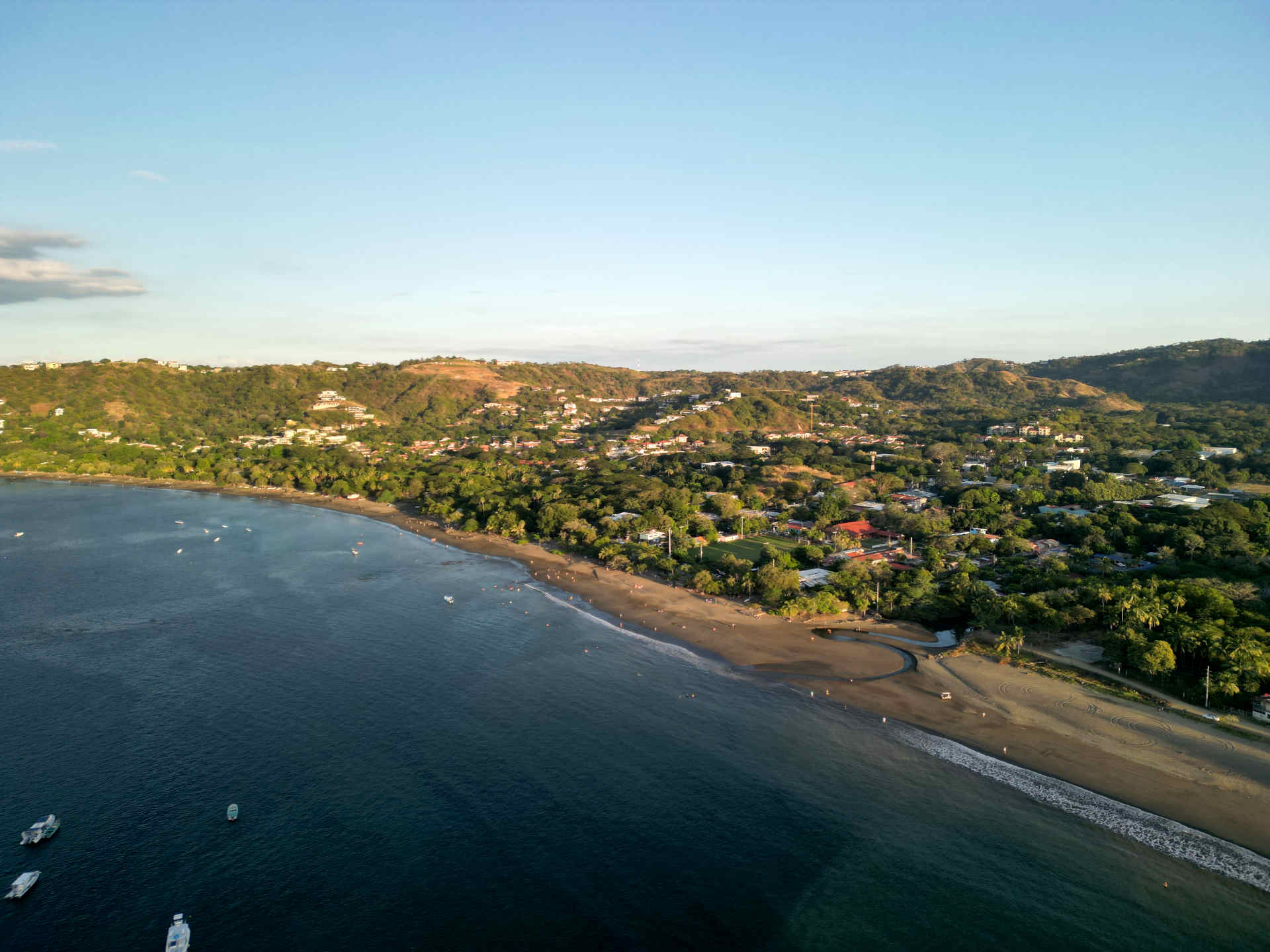
Playas del Coco – high-density condo projects like Las Palmas have made regional water capacity a real-time constraint, not just a long-term question.
Road Widening – the multiplier on everything else
Roads matter here mostly because they compound PAACUME. A new water district with a slow road to the airport is a retirement market, one with a fast road is a rental market. Three projects are the ones to watch:
- Route 21 Tempisque River Bridge overhaul (Guardia, near Liberia) – construction began Nov 21, 2025. 567-day build, roughly US$4.7M. Temporary bypass is in place; full reopening targeted for 2027.
- Route 21 expansion near Liberia Airport – tender released February 2026.
- Route 1 widening (Barranca to Limonal) – 49 km going to four lanes, wildlife crossings and drainage upgrades included, completion expected late 2027 or early 2028.
Anyone who has driven from LIR to the beach communities recently knows the real friction point: Comunidad. Congestion around the Comunidad intersection regularly adds 15–25 minutes to what should be a straightforward airport run. It’s the single choke point that the Route 21 expansion is designed to relieve. Faster access from LIR is already being priced into Flamingo, Tamarindo, and the Papagayo corridor. The less obvious winners are the Route 21 corridor towns (Comunidad, Filadelfia) and, via Route 151 which branches off at Comunidad, to the Playas del Coco corridor including Sardinal.
Route 151 is worth mentioning on its own. It’s the spine connecting Comunidad to Playas del Coco, Playa Hermosa, and Playa Panamá. It also feeds the RIU Guanacaste and RIU Palace resort complex at Playa Matapalo, which is one of the largest all-inclusive operations on the Pacific coast. Further up the coast, the same corridor provides access to the high end developments at Zapotal and Las Catalinas. These are two of the fastest appreciating luxury markets in Guanacaste. Anything that improves flow through Comunidad feeds directly into every one of those markets.
Fiber and Starlink – the quieter value driver
Liberty Costa Rica and Coopeguanacaste are rolling out fiber aggressively in the tourist zones, with additional backbone and last-mile connections targeted for end of 2026. Liberty is also launching Starlink satellite mobile connectivity in the second half of 2026. Starlink itself is already a genuinely viable primary connection in the region. Day to day reliability and speed are on par with fiber for most use cases, and the price point is competitive. This is why it’s already become the default for properties outside fiber coverage rather than a stopgap.
Short term rental performance in Nosara, Tamarindo, and Flamingo has tracked internet quality for years. The gap between “listing with fast fiber” and “listing with unreliable DSL” is visible in nightly rate data. Starlink coverage effectively closes that gap for inland and off-grid properties that were previously hard to rent to remote workers. That’s what makes a PAACUME served inland property actually marketable, which is why it sits above the airport on this list.
Marinas: Flamingo Open, Coco On the Way
The Flamingo Marina Phase 1 has been fully operational since late 2025, with Phase 2 – hotel, additional docks, retail – now underway. Nearby property values have moved accordingly.
The new marina at Playas del Coco has been on the horizon for years. It’s been discussed, planned, and delayed long enough that locals had stopped building expectations around it. So the January 2025 concession signing and the recent Phase 1 start (access road and dredging) are genuinely meaningful. There are 299 berths planned, with the full build out in 3–5 years, though that timeline is worth discounting somewhat given how Costa Rican concessions typically unfold. The upside for coastal Coco property is real, but it will arrive in stages rather than all at once. More on its likely impact here.

Liberia Airport (LIR) set a record ~2 million passengers in 2025 – the demand signal most buyers already know about, which is precisely why it’s no longer where the upside is.
Liberia Airport, Briefly
LIR set a record with ~2 million passengers in 2025, and the new Signature Aviation private jet terminal opens later in 2026 – covered in detail here. It lands last on purpose: airport growth is the most visible item on this list and the most priced-in. It matters for the luxury ceiling, not for where current market inefficiencies sit.
Who should act, and when
The buyer profile that should move in 2026 is the one targeting inland or Route-21-corridor parcels on the PAACUME distribution map. That’s where water, roads, and Starlink-viable internet intersect before the market fully reprices. Luxury coastal buyers have less urgency as LIR-driven demand is already in those prices. Vacation rental buyers should verify internet coverage (fiber or Starlink line-of-sight) street by street before paying a premium for “internet-ready” listings – rollout is uneven, but the tools to solve it for a specific property already exist.
Tracking infrastructure moves across Guanacaste is part of how we advise buyers on where prices are heading. If you want a read on a specific town or property, get in touch.
Frequently Asked Questions
Which Guanacaste infrastructure project will have the biggest impact on property values?
The PAACUME water project is the most consequential of the five. It removes the single constraint – reliable water – that has kept inland Guanacaste parcels cheap for decades, and it also stabilizes supply for high-density coastal developments like Las Palmas in Playas del Coco. Roads, fiber, and marinas amplify its effect, but water is the foundation.
Is Starlink a reliable replacement for fiber internet in Costa Rica?
Yes, for most residential and vacation-rental use cases. Starlink in Costa Rica delivers speeds and reliability on par with fiber, at a competitive monthly price, which is why it has become the default connection for properties outside established fiber zones rather than a temporary stopgap. Liberty’s Starlink mobile rollout in the second half of 2026 expands that coverage further.
When will the new marina in Playas del Coco be fully operational?
The concession was signed in January 2025 and Phase 1 (access road and dredging) is now starting. The official build-out timeline is 3–5 years for the full 299-berth facility plus commercial areas and customs. That schedule is worth discounting – Costa Rican marina concessions typically take longer than their initial estimate – but the project is genuinely moving for the first time in years.